JLPT N1Japanese
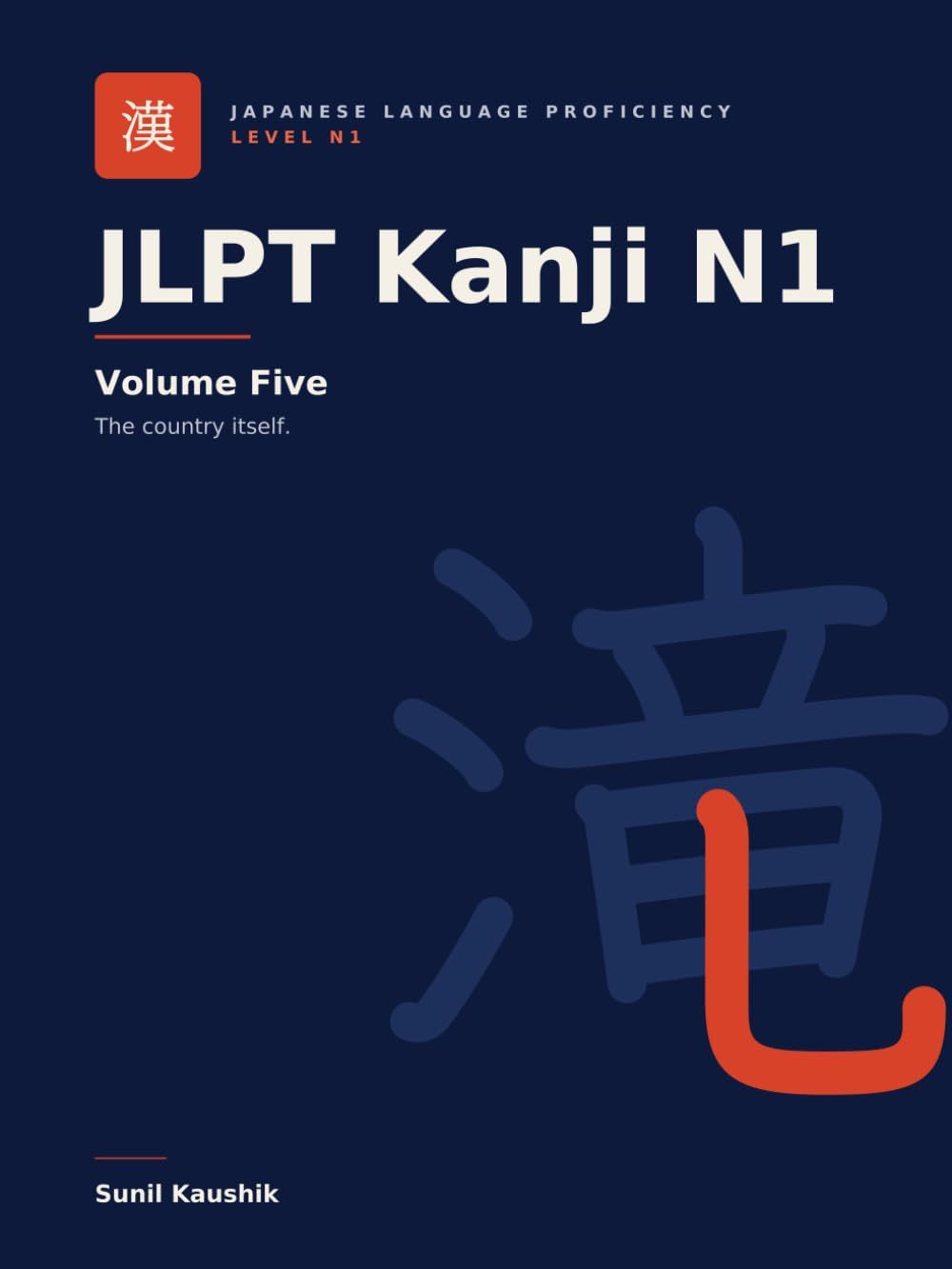
JLPT Kanji N1 — Volume 5
Volume Five — 176 Characters, Taught in Twelve Chapters
“The country itself.”
In short
Volume 5 of the JLPT N1 kanji set: 176 kanji in 12 themed chapters. The country itself. Every kanji gets its own spread with readings, example words, stroke order, practice and sentences with furigana and romaji.
What you get
- Readings you can hear: every on'yomi and kun'yomi with its own example words.
- Stroke order before the pen: each frame adds one stroke, drawn dark over what you have already written in grey.
- Every chapter closes itself: reference sheets, then practice, then the answers.
- Particles, not just meanings: each chapter lists its verbs with the particle each one takes.
- Furigana and romaji on every line, so you can read the whole book from the first page.
- More than 1,900 real sentences, and an index of every character by stroke count.
About this book
N1 is where the written language parts company with the spoken one.
This volume is the country itself: three chapters of water, three of trees, and then the mountains, the weather and the birds, fish and beasts living in them — the half of N1 that a Japanese place name is made of. Every character gets a spread of its own, laid out the same way every time.
Readings you can hear. Every on'yomi and kun'yomi with its own example words, because a reading you cannot hear in a real word is not yet knowledge.
Stroke order before the pen. Each frame adds one stroke, drawn dark over what you have already written in grey — and it comes before the tracing, never after.
Every chapter closes itself. Reference sheets, then practice, then the answers. You never turn to the back of the book for an answer.
Particles, not just meanings. Each chapter lists the verbs it teaches with the particle each one takes — the part nobody teaches and everybody gets wrong.
Furigana and romaji on every line, so you can read the whole book from the first page.
More than 1,900 real sentences, and an index of every character by stroke count with the page it is taught on.
Who this book is for
Teenagers and adults studying Japanese on their own or alongside a class, preparing for the JLPT or simply reading more.
More in this series
Japanese